1. Understanding Quadriceps Anatomy Starts Beyond the Gym
When most people think of Understanding Quadriceps Anatomy, they imagine bulging thighs and strength machines. Yet this muscle group, spanning the front of the thigh, does far more than power leg extensions. It acts as a dynamic communicator—balancing posture, guiding movement, and even signaling fatigue or emotion. Forget the sterile anatomy chart; the quadriceps tell stories every time you climb stairs, stand up, or fidget during a meeting.
2. The Fourfold Design: Quadriceps as a System, Not a Single Muscle
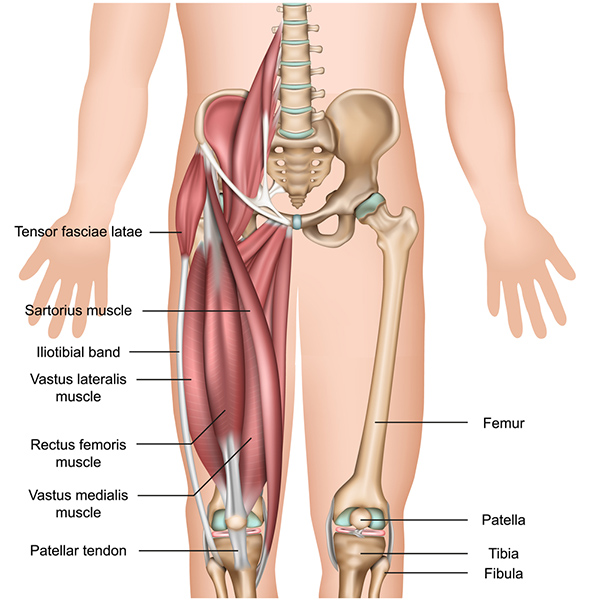
“Quad” means four, but Understanding Quadriceps Anatomy reveals a complex collaboration:
-
Rectus femoris – crosses both hip and knee, connecting sitting to standing.
-
Vastus lateralis – the outer powerhouse, driving explosive action.
-
Vastus medialis (oblique) – the stabilizer that whispers precision, not force.
-
Vastus intermedius – the silent worker deep beneath, providing endurance.
Rather than four independent actors, the quadriceps function as a living network. When one tightens excessively, the others compensate, altering gait patterns and balance. This isn’t just muscle tissue—it’s an orchestra.
3. The Forgotten Emotion of Movement
Understanding Quadriceps Anatomy means recognizing the emotion embedded in motion. Tight quadriceps often signal anxiety or overdrive—body language frozen into muscle tension. Ever notice how people under stress stand rigid, knees locked, thighs tense? The quads mirror psychological strain.
Yoga and somatic therapy frequently release emotional tension from the thighs, showing that anatomy isn’t mechanical—it’s expressive.
4. Evolutionary Intelligence: Why Quadriceps Made Us Human
The leap from four legs to two demanded mastery of balance and control. Understanding Quadriceps Anatomy explains our species’ signature—bipedal locomotion. The quadriceps became architects of upright posture, managing gravitational tension and stride rhythm.
When humans began running long distances, the quads learned endurance instead of raw power. They evolved not just for movement, but for persistence—chasing prey, traveling continents, surviving time.
5. Modern Life: How Sitting Betrays the Quadriceps
Ironically, the muscle that once carried humanity forward now suffers from stillness. Understanding Quadriceps Anatomy in modern terms reveals the tragedy of the chair. Hours of sitting shorten the rectus femoris, tilt the pelvis, and silence vastus coordination.
The result: knee pain, weak glutes, and “dead quads.” This is not a training issue—it’s an environmental mismatch. The quadriceps were built to move through landscapes, not swivel chairs.
6. The Art of Functional Strength
Strength isn’t measured in leg press plates—it’s measured in control.
When Understanding Quadriceps Anatomy, think less about hypertrophy and more about intelligence. True functional strength means the ability to move fluidly—lowering into a squat without pain, catching balance mid-step, rising with ease.
Exercises like split squats, Bulgarian lunges, and controlled step-downs build harmony among the four heads. The quads thrive on movement quality, not just intensity.
7. Quadriceps and the Kinetic Chain: The Hidden Dialogue
No muscle works alone. Understanding Quadriceps Anatomy reveals a dialogue between hips, knees, and ankles. When the quadriceps dominate, the glutes and hamstrings retreat, and the body loses rhythm.
Knee discomfort often stems not from the joint itself but from this imbalance. Re-educating the quadriceps means restoring that chain reaction. Foam rolling, neuromuscular reactivation, and barefoot grounding help rewrite these forgotten connections.
8. Quadriceps as Teachers of Posture
Your posture is a reflection of how your quadriceps negotiate gravity.
In Understanding Quadriceps Anatomy, alignment is a conversation between front and back—quads and hamstrings, flexors and extensors. Overactive quads pull the pelvis forward, curving the lower back; underactive ones leave the knees unstable.
Releasing tension and retraining length through mindful stretching—like supported lunges or standing quad holds—returns symmetry to the body’s architecture.
9. Breathing Through the Thighs: Somatic Awareness in Motion
It may sound poetic, but Understanding Quadriceps Anatomy benefits from breath. Deep breathing connects diaphragm to pelvic floor, creating a kinetic wave through the torso and legs.
When you breathe fully during a squat, the pressure system stabilizes your spine and empowers your quads to act with precision. Breath transforms exertion into flow—turning muscle effort into grace.
This isn’t anatomy as memorization—it’s anatomy as mindfulness.
10. Reimagining Strength: From Mechanic to Meaning
The final lesson in Understanding Quadriceps Anatomy is philosophical: muscles are memory. They carry the history of evolution, the strain of modern habits, and the possibility of transformation.
To train the quadriceps is to engage with this story. Strength is not only built—it’s remembered, reconnected, and expressed through every stride and step.
So, the next time you rise from a chair or ascend a hill, realize your quadriceps are not just lifting your body—they’re lifting your history, emotions, and awareness.
Conclusion: The Living Map Beneath the Skin
Understanding Quadriceps Anatomy isn’t about memorizing four Latin names—it’s about decoding the intelligence of movement. These muscles remind us that anatomy is not static; it’s dynamic, emotional, and beautifully alive.
Your quadriceps don’t merely extend the knee—they extend your ability to participate fully in the act of being human.
About the Author